Monday, November 09, 2009

32. Hai Nan Shan Tian Gong Tan 海南山天公坛

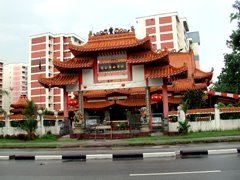
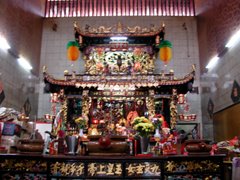
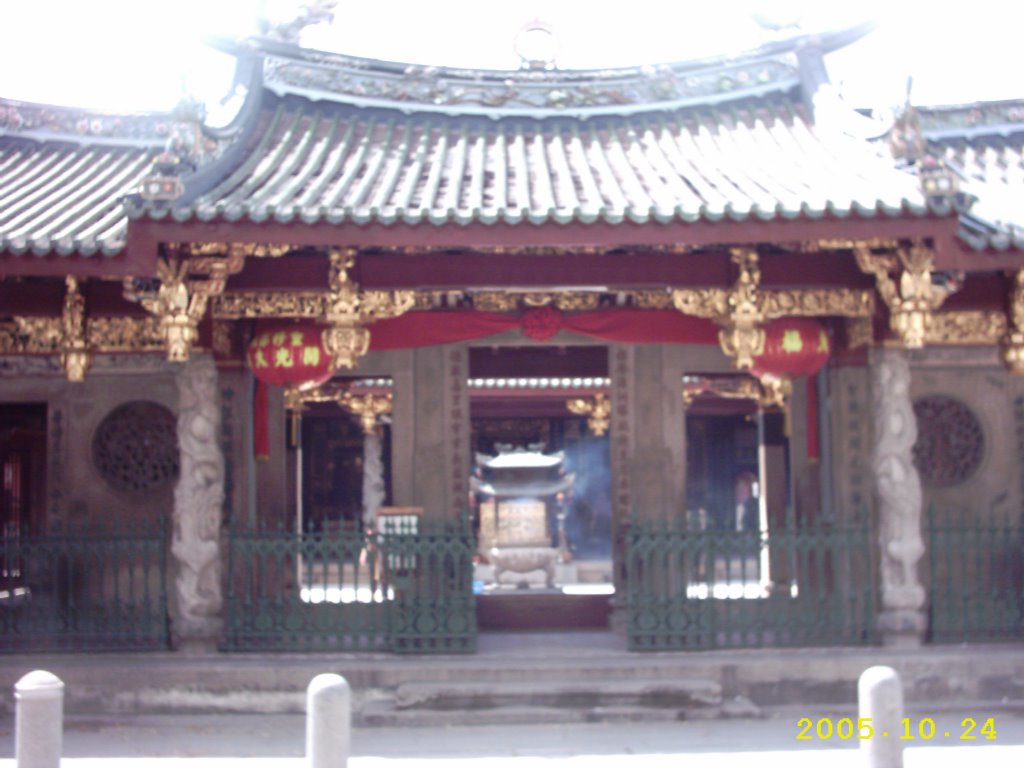
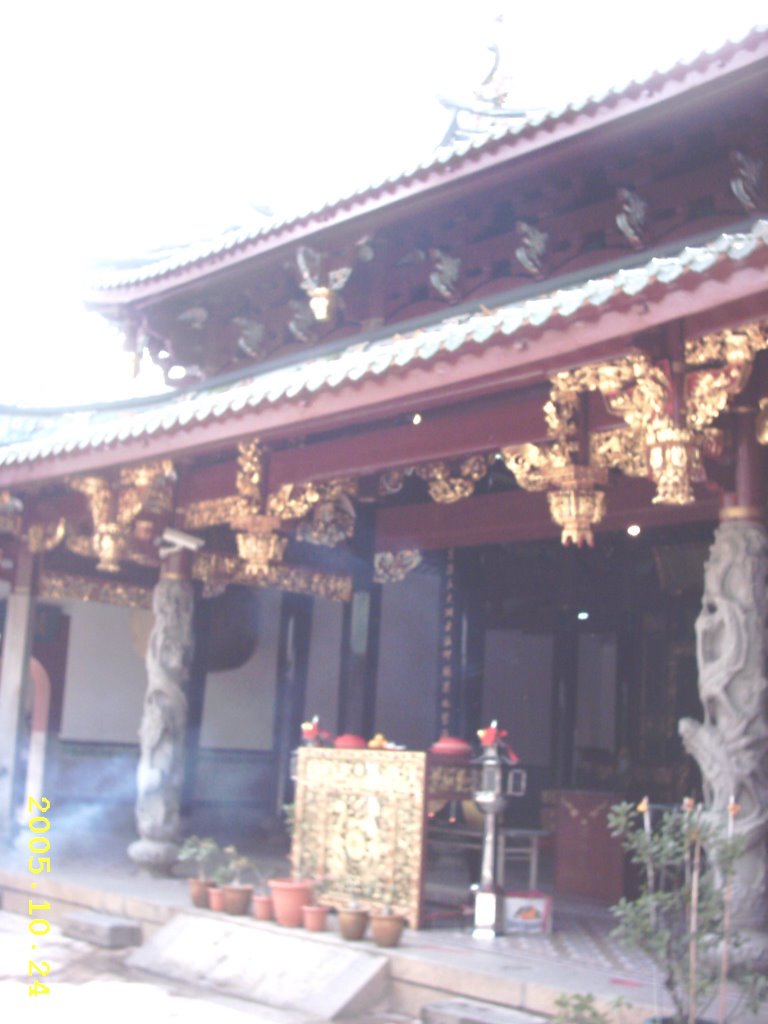
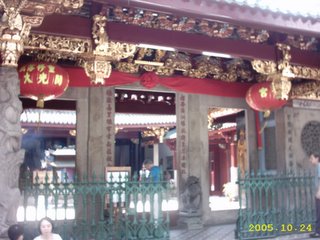
Nested at the corner of Upper Thomson Rd (175) with the former Lakeview Estate (now no more there), in a narrow strip of land, stands the  Hai Lam Sua Ti Kong Tua  海南山天公坛 (Hai Nan Shan Tian Gong Tan). This year, 2009, the temple celebrates its 105th Anniversary from 14Nov to 23Nov.


This temple must have seen the changes in this area known as Hai Lam Sua 海南山 (Hai Nan Shan) since 105 years ago. Over the years, the temple has also evolved, through renovation and just a couple of years ago, it was rebuilt to what it is today.


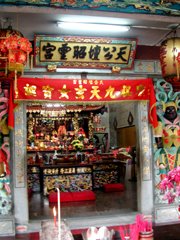
This temple is probably the only Jade Emperor 玉皇 Temple in this vicinity. In the temple, the other two deities are Tua Pek Kong 大伯公 (Da Bo Gong) and Guan Yin 观音.

Thursday, September 03, 2009

Chinese Temples 庙宇文化 Book 3 is out!

The third volume of Chinese Temples in Singapore, Miao Yu Wen Hua 庙宇文化, has been released and are available at most newspaper stand.

Friday, June 26, 2009

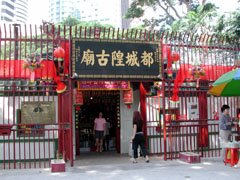
31. Shuang Lin Cheng Huang Miao 双林城隍庙


If you go in by the main entrance to the well known Shuang Lin Si, you would have notice this rather old looking temple near to the gate.

According to the notice in the temple, this temple was built in the 29th year of the reign of Emperor Guan Xi, 1903. This temple could be one of the oldest if not the oldest Cheng Huang (City God) temple in Singapore.

Inside the temple building was just one huge hall with a high ceiling. It is possible that the Deities could have been added in this temple over time. Some of the statues could be very old from the look of the sculpture, and yet some of them looked rather new. Many of the statues of the Deities have their names placed in front of them, thus, making easy identification.


This temple has a pair of unique lion statues that seem to be laughing all the time. And there is also a pair of horses that looked almost comical with the pakchoy and carrot placed on their heads. To the devotees, it mean something to them.

On the right hand side of the temple, as you walk in, you will find the famous Tiger God. In this temple, there is someone who offers services for any devotee who want to have special rituals conducted with respect to the Tiger God. It is said that if one has back-stabbers (probably in business or workplace), one could come to seek protection from the Tiger God.

From morning to evening, this temple is never short of devotees, who come, offer their prayers, and leave, each at his or her own time and pace.

Sunday, May 31, 2009

30. Chwee Hean Keng 水显宫 (Shui Xian Gong)

This is one of the few temples dedicated to Sam Tiong Ong 三忠王 (San Zhong Wang), deities from the late Song Dynasty, Wen Tian-Xiang 文天祥, Lu Xiu-Fu 陆秀夫 and Zhang Shi-Jie 张世杰. This temple, located at Zion Road, is standing on a piece of land that has been en-bloc for redevelopment. This temple has been here for at least more than 70 years, witnessing the changing tributary of the Singapore River - when the descendants of the great tongkang builders from China continued their tradition for the busy Singapore River further downstream, the big Bukit Ho Swee fire, of which it stood while the surrounding attap houses burnt down, and how the "phoenix" rose from the fire in the forms of HDB flats, and it itself now might not survive the demolition ball.

Inside this temple, there was a framed picture dedicated by the Lu Clan Association, showing a statue of Lu Xiu-Fu, with a brief history of the three matyrs of the Song Dynasty. I reproduce it here for better understanding:

Wen Tian-xiang, Lu Xiu-fu, and Zhang Shi-jie were the three patriotic officials of the late Song 宋Dynasty period. In 1275 A.D., the Yuan 元 army came south to invade China. The three of them organised more than 10,000 volunteers in the capital city of Southern Song 南宋, Lin-an  临安(present Hang-zhou 杭州, to fight the enemy. In 1276 A.D., Wen Tian-xiang was appointed the Chief Minister in charge of the non-military affairs, and Lu Xiu-fu the Chief Minister in charge of military affairs. Later, when the capital city was occupied by the Yuan army, they led the troops, retreating to coastal provinces including Zhe-jiang 浙江, Fu-jian 福建 and Guang-dong 广东.

They continued the struggle with the Yuan army proclaiming Zhao-shi 赵是 and Zhao-bing 赵昺as successful emperors. In 1278 A.D., Wen Tian-xiang was captured after this troops were defeated. In prison, he wrote the famous Zheng-qi song 正气歌 to express his sense of patriotism and loyalty, resisting the threats and briberies of the Yuan regime. In 1283 A.D., he died in prison heroically. In 1279 A.D., Lu Xiu-fu and Zhang Shi-jie escaped to Ya-san 崖山 in Guang-dong province, together with the young emperor Zhao-bing. The Yuan troops were hot on their heels. The situation was made worse by a typhoon. Zhang Shi-jie attempted a break-through with his troops. His ship capsized and he was drowned. Lu Xiu-fu realised that the situation had become hopeless. Carry emperor Zhao-bin on his back, he and his wife ended their lives by jumping into the sea. Later, the people admired the patriotism of these three great officials and worshipped them as the three patriotic lords of the Song Dynasty.

This temple carries with it its stories, most of which would be lost because all are orally transmitted down the generations. I was told that this temple was a result of an exchange of two temples between San Zhong Wang and Guang Ze Zun Wang. As it turned out Guang Ze Zun Wang's temple further down the river was burnt down and this temple was most of the time indunated with flooding water, especially during the extreme high tide. Could well be a myth.

It was almost like a temple as a stranger in its own surrounding as the residents moved to various parts of Singapore. But each year, during its festive days (9M16), the loyal devotees remember and would return to pay respects to their three patriotic lords, a constant reminder of what they should be.

Links

Monday, May 18, 2009

29. Guan Hock Dian 圆福殿 (Yuan Fu Dian)

Also known as Tua Kang Lai Temple (because it is near to a canal), this 100+ year old temple is now the witness to the rapidly evolving Singapore, in a sea of modern terrace houses and tall condominiums. In its days, it was surrounded by attap houses where most of the villagers were said to come from a same area in AngKuei (Anxi) in China. Most of them have the Chua (Cai) surname.

The main Deity of this temple is Dang Kong Jin Lin 董公真人(Dong Gong Zhen Ren). This Deity, from the statue and a framed drawing, looks like a Buddhist monk. This temple was the centre of worship to the village in the old days and is said to be well known as far as Jurong and Changi. With the support of villagers and devotees, the temple was rebuilt and renovated many times to what it is today. The soggy ground during rainy days were concretised. This is probably the only temple in Singapore with the most well kept (and renovated) permanent opera stage.

There are five Deities on the main altar, and Guan Yin on the side. The five deities are: Xie Tian Da Di 协天大帝 (Guan Gong), Wu Gu Zhen Xian 五谷真仙, Fu Xi Xian Di 茯羲仙帝, Fan Hou Xian Shi 范侯仙师, and Dong Gong Zhen Ren 董公真人. Will need Bro Jave to enlighten us more about the deities, especially Fu Xi Xian Di, Fan Hou Xian Shi and Dong Gong Zhen Ren.


The temple festive dates are:

5M08 & 08: In honour of Xie Tian Da Di 协天大帝

8M08 & 09: In honour of Wu Gu Zhen Xian 五谷真仙, Fu Xi Xian Di 茯羲仙帝, Fan Hou Xian Shi 范侯仙师

11M09 & 10: In honour of Dong Gong Zhen Ren 董公真人

The Location:
Guan Hock Dian 圆福殿
Yuan Fu Dian
Tua Kang Lai Temple
14 Jalan Kabaya
tel: 64667423

Saturday, May 16, 2009

28. Tian Teck Keng 天德宫 (Tian De Gong)

Tian Teck Keng has its origin in a kampong behind the Rochor Tua Pek Kong Temple, off Balestier Road. In the old days, when there were no temples, the families of the village would come together each year to celebrate the "deity of the village" and they would pua-puay (using the divination blocks) to seek for Lor-Chu (head of the joss urn). In this village, they did the same for Nezha - Lian Hua San Tai Zi 哪吒 莲花三太子. Whoever got the lor-chu will bring home the statue of Lian Hua San Tai Zi and the joss urn home to worship the deity till the next year. And so, the Deity made his round of the homes in the village, depending on who is keen to "apply" to host him. The TiKong (Jade Emperor) urn dated 1922 still exists today. This means probably the practice was carried out way before that. The temple has just celebrated its 87th Anniversary this year, 2 May 2009 (4M08).

Later, it was decided that there should be a more permanent place for Nezha and so, they built a wooden hut under the Spirited Tree in the same compound as Tua Pek Kong but had to move to behind the temple, renting a space from Hokkien Huay Kuan. 

Some 16 years ago, under the urban renewal programme, the temple in wooden structure had to go. With some compensation, it moved to 37 Kim Keat Lane where it stayed for 8 years. It then moved to Geylang Lorong 3 (the famous temple squatters) where it stayed for 3 years before moving to the current temple at Tampines Link.

The temple now has 44 years to stay put in this place until the expiry of the lease. The current temple is in a bigger temple complex housing the other two temples, Poh An Keng (Bao An Gong) and Kao Tiao Kio (Jiu Tiao Qiao) Temple.

Location
95 Tampines Link #01-03  
Singapore 518486
Tel: 6787 9618
Fax: 6466 6863

http://www.ttktemple.org.sg.

Wednesday, May 06, 2009

Book: Through the Bamboo Window

You might wonder what the Chinese temples in Singapore were like in 1950s. Thanks to the Singapore Heritage Society and additional hardwork put in by the original author of this book "Chinese Temples in Singapore", Dr. Leon Comber, this book combined with Dr. Comber's other books were put together and reprinted as "Through the Bamboo Window". And now, you have a chance to look through the bamboo window to what Chinese temples were like in Singapore in the 1950s.


Some of these temples are still around. Some were gone. It would be a delight taking this new old book on a tour of the mentioned temples and comparing what they are today. The book is now available at all major bookstores in Singapore and through the internet as well.

Thanks to the observant eyes of this "angmoh lang" (the Hokkien description of a caucasian), we have part of the history of Singapore temples captured and frozen through time.

Monday, March 30, 2009

27. Long Shan Gong 龍山宫

A very simple temple nested in the valley surrounded by condos, this little temple lives to tell of its old days and its contributions to the village in this valley. This temple is dedicated to Oon Kim Lau Hu Dai Lin (Wen Jin Liu Fu Da Ren), the patron deities of the Lim Clan.

This temple has a 100 year old history and is linked to its mother temple in Angkuei (Anxi), China. This temple was built sometime at this place at Lorong Puntong in the 1980s, after the piece of land, on which this temple stands, was offered back to the temple after development of the area was completed. The original temple could have been an attap shed in this area since long ago, when a piece of land was offered by a person for this temple to be built, to be dedicated to Wen Fu Da Ren. During the urban renewal and this land was being developed by a private company, the Deities of the temple went on a journey throught 6th Ave and then Clementi Ave 4 before returning to its place of origin in Singapore.


This temple continues with its annual celebration on the 3rd and 4th of the 8th Lunar Month.

Saturday, February 28, 2009

26. Feng Huo Yuan 风火院

Nested in this lane, which is considered as part of Paya Lebar Road, are two temple complexes, all new generation temple buildings built as a result of urban renewal in Singapore.

This is one of the two temples in this complex, Feng Huo Yuan 风火院. Interestingly, if you look at the name at the temple, you would see the word "Huo" (which is fire) up-side-down. It could be in the belief that if it is written this way, then the fire would not come alive!

I could remember long long ago when I first visited this temple (which was already built), an old man was sharing with me the stories of olden times, when it was still farm land in this area. Under the renewal programe, the small temple (probably in a hut or so) had to make way, but he told me that the main deity refused to move. And so, the devotees had to see how to keep the temple in its place. Alas I did not have the chance to follow up, but happy to note that till this day, this temple is still there. It probably still has a story to tell of the olden days with its neighbourhood forming the devoteeship.

This temple is dedicated to, amongst the many Deities, Hong Jun Fa Zu 鸿钧法祖 (known to the Hokkiens as Ang Kun Huat Chor or Ang Kun Lor Chor). While there are a couple of such temples dedicated to Hong Jun Fa Zhu in Penang, Malaysia, in Singapore, it is rare.

This temple has an active group of members practising the tradition of the cultivated Tao. They even produce CDs of their chanting, to be given away free. You can get copies from the temple.

Tuesday, October 14, 2008

Nine Emperor Gods: Long Nan Dian sendoff

Long Nan Dian sent off Nine Emperor Gods in a rousing ceremony at the East Coast Parkway on 7 Oct 08 (9th day if the 9th moon).

There were nine palanquins in the send-off.


Friday, July 04, 2008

25. Jiu Xian Gong 九玄宫

The Jiu Xian Gong 九玄宫, the shortened name for 九天玄女真仙。俗称玄女妈宫, started in 1928 by the Bai Clan at 7 milestone, Tampines Rd. In 1970, owing to rapid urbanisation, the temple started looking for a more permanent place for the temple. In 1982, a piece of land at Tampines Road was found and in 1985, the temple was built.
Many of the devotees and supporters of the temple are still from the Bai 白 Clan. Today, the temple stood tall at one end of the row of temples along the Old Tampines Road. Recently, further renovation to the temple was made.


This temple's main diety is Jiu Tian Xuan Nv 九天玄女. Jiu Tian Xuan Nv has a very long history and is well known amongst the Chinese people.

Monday, February 12, 2007

Second Book on Chinese Temples launched

The second book on Chinese Temples has been launched by Shin Ming Daily on 1 Feb 2007. Costing S$5 a copy, this book covering some 40 Temples are available in newstands and major bookstores.


Saturday, August 26, 2006

24. Jin Long Si 金龙寺

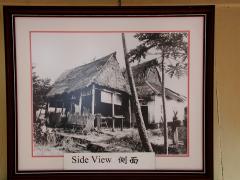
A temple that started off in an attap shed on a land donated by a grateful jeweller during WWII (1941), Jin Long Si, 金龙寺 (originally known as Jin Long Miao) was later rebuilt into a zinc-roof and wooden structure. It has since stood still with passing time. Today, this unique structure in the midst of rapid developments in the Lorong How Sun (off Bartley Rd & Upper Paya Lebar Rd) area, which is as busy as before, stood still in time, reminding us of the kampung days in this area and in Singapore.

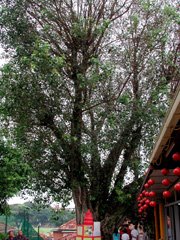
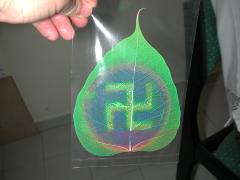
What is older than this temple is the Bodhi tree that probably has recorded the development or evolution of this temple with passing time and the generations of villagers and worshippers. It stands there, each day watching the worshippers pray or chants. As the 94 year old temple keeper shared her story, whenever she had time, she would come to the tree to meditate. This elder Bodhi tree is said to be about 100 to 120 years old.

Located in a very good fengshui point, this temple and tree have grown into a symbiotic relationship. This could not have been better described than by a father and son devotee of the temple. The tree reminds them of their late wife and mother, and the tree brings peace to them, as with the chanting inside the temple.

While this temple is now actively involved in Buddhist chanting, it is a san-jiao (three religion) temple with teachings derived from the great books of Buddhism, Taoism and Confucianism. The teachings of the late master continued to be shared with the devotees each Sunday afternoon through a tape player.

This temple also has many unique Taoist Deities like Nan Wu Wu Ji Sheng Mu and Pan Gu. There must be something in this temple that inspires the artistic talents of the devotees. In the short history of the temple (65 years), the devotees had made a huge statue of the Laughing Buddha out of saw dusts (similar to those used for making joss sticks), built a pagoda and also a pavilion with the life size statue of Nan Wu Wu Ji Sheng Mu.

Devotees of the temple get to take vegetarian meals after the chanting. The vegetarian dishes were created and cooked with such loving care that they are probably the best secrets kept in Singapore. No money can buy. (^^)

At this moment, this temple is in danger of disappearing soon. The Buddhas and Deities willing, it might be a short time left for anyone to enjoy (appreciate) one of the last remaining bastion of rural Singapore temple.

The place: Jin Long Si, Lorong How Sun

Sunday, July 16, 2006

23. Seng Wong Beo 都城隍古庙

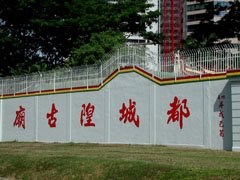
Seng Wong Beo, as is more popularly known to the older generations in Singapore, was a landmark in Tanjong Pagar. It is still a landmark, an ancient structure dwarfed by the huge and tall concrete skyscrapers. This year, 2006, it celebrates its 101st year of existence.

Painted with both strokes of the Chinese brush style on the exposed outside wall of this temple is Du Cheng Huang Gu Miao 都城隍古庙. Cheng Huang is translated as City God in English.

This temple has an interesting history. It was founded by a Buddhist monk although the temple is more Taoist in nature. It can be considered as a syncretic temple, which is quite common in the Chinese temples in the early days of Singapore.

This temple is also well known as the temple where ghost-marriages are arranged. According to sources, sometimes, a family member of a deceased relative (single who died young) might have a dream about being requested to arrange a marriage for the deceased. Chances are it would be the mother who dreams about it. In about the same time, another family might have a similar request. This temple does "match-making" too, matching them according to the descriptions. This is but one aspects. The SPI website has a more detailed report on this.

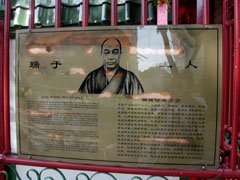
Below is an interesting account which was posted on a signage outside the temple, explaining on the history of the temple.

Seng Wong Beo Temple

The temple was founded by Reverent Swee Oi from China. The Reverend whose family name was Huang, was educated and well versed in poetry. He was an imperial scholar during the Qing dynasty. However his keen interest in Buddhism led to his decision to become a monk. He was ordained in Fuzhou Quanzhou.

He later came to Singapore where he saw many Chinese who sailed in boats from China and settled mainly in the Tanjung Pagar and Telok Ayer areas. They worked mostly as labourers in the harbour and also as rickshaw pullers. Their life was hard. Falling ill and feeling lonely and home-sick were common. Their hardship touched Reverent Swee Oi who then decided to build a temple in Tanjung Pagar. He wanted these people to have a place where they can worship and pray for the well-being of their loved ones back home in China.

The temple was first built in the 31st year of the Qing Emperor Guang Xu's reign. Two years later, the then Chinese Consul to Singapore, Zuo Bing Long, personally wrote a tablet and presented it as a gift to the temple. The tablet still hands in the main prayer hall of the temple.

The temple worships the City God. According to Chinese beliefs, the City God guards the city from evil. Devotees come to the temple to pray for the country's peace and prosperity, for the triumph over evil and for the good health of all. The City God rewards good deeds and punishes the evil ones. He also has the responsibility to guide souls of the dead to the underworld. His temple has ben and continues to be a place of solace for its many devotees.

Saturday, May 20, 2006

22. Tian Gong Tan Zhao Ling Gong 天公坛昭灵宫

There are three temples in the Jurong West Combined Temple 裕廊西聯合宫 [Yu Lang Xi Lian He Gong] located at the corner of Jurong West St. 41 and 51. Looking at the front of the temple, from the left, West Coast Hock Teck Si (Xi Hai An Fu De Ci 西海岸福德祠), Tian Gong Tan Zhao Ling Gong 天公坛昭灵宫, and Xian Long Gong 显龙宫.

In this report, I shall just focus on Tian Gong Tan Zhao Ling Gong.

Tian Gong Tan Zhao Ling Gong 天公坛昭灵宫 has a plaque that briefly described the temple's history and how it was originally merged between the Tian Gong Tan 天公坛 and Zhao Ling Gong 昭灵宫. Reproduced below, with some additions from the Chinese version, is the temple history from the temple's plaque.


Tian Gong Tan Zhao Ling Gong Temple"Tian Gong Tan" was a wooden temple erected [in 1917] by the villagers for the worship of "Tian Gong 天公" and "Qian Shou Guan Yin 千手观音" as well as celebrating "The Hungry Ghosts Festival 中元节" in the 7th Lunar month. it was located at Clementi Park along Sunset Grove.

"Zhao Ling Gong" worships the "Jiu Tian Xuan Nu 九天玄女" and "Zhu, Xing, Li Da Ren 朱,邢,李大人". It was migrated to Singapore from China, Fujian, Anxi province [Gong De Li 公得里(Neighbourhood) Ma Tou Xiang 马头乡(Village) with Mr. Koh 许 (Xu) in the 1930's. After several settlements, it was last settled in Clementi Park. Mr. Koh performed as the Medium and the prayers was carried out in his house. The villagers believed the Holy spirits of "Jiu Tian Xuan Nv" because they will have a peace of mind after the prayers. In order to have a more convenient and comfortable place of worship, the villagers and Mr. Koh came to a concensus in 1943 that the deities of "Zhao Ling Gong" joined "Tian Gong Tan". [In 1975, they started the first management committee, celebrating the Tian Gong's birthday on the 9th of 1st lunar month, celebrating the birthday of Jiu Tian Xuan Nv on 15th of 4th lunar month and the Hungry Ghost Festival on 1st of the 7th lunar month.]

In 1983, the temple site was affected by resettlement and was ordered to move by the Authorities. The villagers and enthusiastic believers formed a Preparatory Committee in 1988 with the name of "Zhao Ling Gong" to raise funds and activities were carried out for about five years to raise the funds needed.

On 28 Feb 1992, the Preparatory Committee jointly bought a piece of land from HDB Land Office, with Shan Leng Temple and West Coast Hock Teck Si, which is located at Jurong West St 41 (current location), 1800 m2 in area for a term of a 30 year lease. The construction of the new Temple commenced on 14 Mar 1993 and was completed after two years.

In 1993, with the name of "Tian Gong Tan Zhao Ling Gong" Temple, the committee applied for registration as a legal society. The application was approved in 1994.

The deities entered the new Temple on 30 Oct 1996.

The main events of the Temple:
(1) Tian Gong's birthday: 9th day of the 1st Lunar month
(2) Jiu Tian Xuan Nu's birthday: 15th day of the 4th Lunar month
(3) The Hungry Ghost Festival: 1st day of the 7th Lunar month

Friday, March 10, 2006

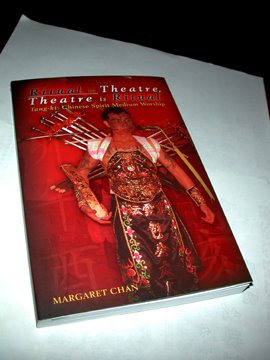
Book: Ritual is Theatre, Theatre is Ritual

This book: Ritual is Theatre, Theatre is Ritual: Tang-ki: Chinese Spirit Medium Worship by Margaret Chan is probably the first English edition book on Tang-ki worship in modern day Singapore. This book is also a Tangki Worship 101 for many who might have witnessed numerous such events in Singapore and yet have no idea on what they were all about.

This book is both for those "inside" and those "outside". Many Singaporeans probably have a hard time explaining to their foreign friends about this interesting and colourship worship. Tang-ki worship is also very much an oral tradition, where knowledge is passed down from grandparents to grandchildren, and much detailed information has been lost. So, this book is certainly timely, especially for present day kids and adults alike who are asking to understand and know more about what their grandparents and parents have been and are worshipping.

Certainly a good guide book for one to read before and after attending a temple event where there are tang-kis (spirit mediums). This book is now available in all major bookstores in Singapore.

Ritual is Theatre, Theatre is Ritual
Tang-ki: The Chinese Spirit Medium Worship
By Margaret Chan

Published by
Wee Kim Wee Centre
Singapore Management University& SNP International

ISBN : 981-248-115-X
Bookshop Price: S$39.90

Saturday, March 04, 2006

Fire Dragon 火龙 at Man San Fu Tat Chi 万山福德祠

The Fire Dragon 火龙 is another form of the more commonly seen and known Dragon, which is usually made of cloth material. The Fire Dragon (Huo Long) is made from straws from the padi (also known as Straw Dragon or Tau Chao Long 槄草龙). In Singapore, it is said that only the Man San Fu Tat Chi 万山福德祠 (or Wan Shan Fu De Ci in Mandarin) in the Sar Kong (Sha Guang 沙冈) village - which is now just recognised as Sims Drive - has this Fire Dragon as part of its traditional temple event.

It is in fact quite rare to see such a dragon and the performance with this dragon. So, it was fortunate for me to be able to witness this interesting event. I think we can say that this is a Cantonese tradition. This year, on the 2nd of 2nd Lunar Month, the temple celebrates the birthday of Tu Di Ye Ye with this Fire Dragon, 6 lions and a three-day Cantonese Opera from Hongkong.

Some 3 months before this date, the only expert in Singapore started making the Fire Dragon with padi straws imported from China. He had to make parts of the body hard with these straws to allow sticking of the bigger than usual joss-sticks, and flexible ones to link between sections of the body. The head and the tail are probably the more difficult ones. It is another form of art. And for the performers, this would still be slightly different compared to the normal dragon.

The event started with temple members and devotees lighting the big joss sticks and stick them firmly onto the head, body and tail of the dragon. The 88 metre long dragon must have had hundreds of joss sticks stuck in its body. There was also the pearl ball which is also stuck with joss sticks.

After the ceremonly of bringing the dragon to "alive" by marking the vital parts of its body by the guest of honour, the dragon came alive. Under the able hands of the leader and troupe members, it was awesome the way the dragon floated in the air, twirling and swirling in the tight courtyard. On the dim road the dragon radiated its lights from each and everyone of the joss sticks stuck on it and the smoke gave an impression of the dragon cruising amongst the clouds. The occasional rubbing of the body gave rise to "sparks" adding on to the sparkles of the dragon.

After a walk along the "kampung" (village), the dragon came back to the temple and after paying its final respect to the Deities, was put to rest outside the temple. Here, they waited and let the joss sticks bring flame to the dragon, sending it off to the heavens with all the ills posted by the devotees. Indeed, over half an hour or so, the dragon was engulfed with flames and to the cheers of "Huat ah, huat ah", the smokes went up as the ashes fell down. An event that not many Singaporeans are even aware of. (^^)

Thursday, February 23, 2006

21.Thian Hock Keng Temple 天福宫 (Temple of Heavenly Happiness)

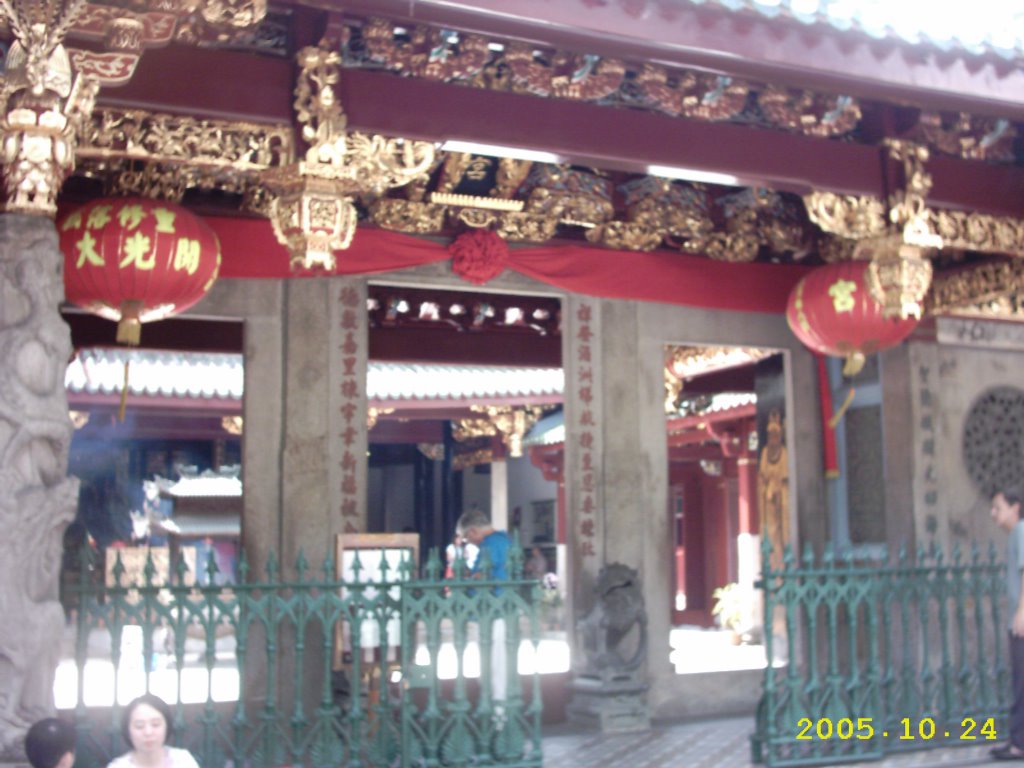
Claimed to be the oldest and most important Hokkien temple in Singapore, this place of worship houses a number of relics, some reputed to be several centuries old, which have been brought over from China. It was gazetted as a national monument on 6 July 1973. Thian Hock Keng has undergone several renovations, the latest in 1998.


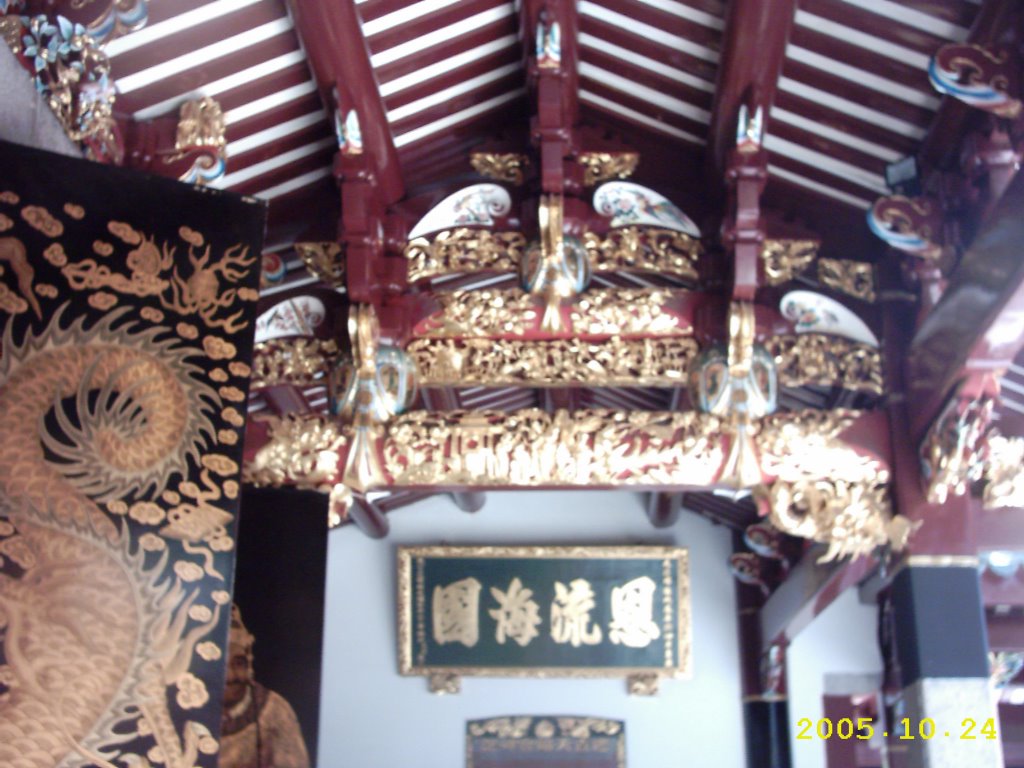
Completed in 1842 to replace a simple joss-house built some two decades earlier, not a single nail had been used in the construction, not even for its pagoda-shaped roofs. Instead the entire structure is supported by iron-wood posts and granite imported from China. The temple boasts of gilded carvings, tile roofs adorned with dragons and phoenixes, intricate sculptures from China, pretty blue porcelain tiles from the Netherlands, and cast-iron railings from Scotland. The early builders understood well the significance shapes play in temple architecture, and the Thian Hock Keng is a fine example. It has windows that are circular to symbolize heaven, square to symbolize the earth, and tiles which were meticulously laid out either in square patterns to symbolize the mouth, implying that one would never go hungry here, or in an upside down “V” pattern, symbolizing “ren”, the Chinese word for “men”, to suggest that one can regard this place as a sanctuary.


According to Geraldene Lowe in her book, “Chinatown Memories”, some materials used in the construction of the temple had been salvaged from junks plying between China and Singapore. Crockery broken during the rough journey were recycled too, turning up as mosaic pieces adorning the feathers of birds, petals of flowers and on other ornaments dotted throughout the temple.


Tan Tock Seng who contributed $3,0474.76, then a princely sum, for the temple building fund, topped the donor’s list. This information, along with that on the founding of the temple, are inscribed on plaques installed near the main entrance.

Guarding the majestic entrance to the temple are two stone lions. The female one holds a cup representing fertility while her male counterpart holds a ball, symbolizing abundance. Before entering the temple, a devotee has to cross a rather high threshold. This is deliberate. For one thing, it forces him to cast his sight downward, an expression of humility, as is expected when one enters a sacred building. Another purpose is to keep out wandering malevolent spirits – it is believed that ghosts shuffle when they move, so this threshold was placed to trip them up. The more pragmatic would explain that the threshold is keep flood waters at bay, since the area was susceptible to flooding.


One of the main deities in the Thian Hock Keng is Mazu (Goddess of Seafarers/Patron of Sailors). She is accompanied by her two sentinels, one with vision that spans 1,000 miles and another gifted with ears that could hear 1,000 miles away. Years before the land in front of Telok Ayer basin was reclaimed and named Collyer Quay, Hokkien immigrants would step out of their junks somewhere behind Telok Ayer Street, possibly very close to the Ying Fo Kuan, a Hakka Association Hall established in 1822. Fresh off the boat, these chaps would invariably head for a “joss house” to give thanks to the Gods for their safe arrival after a long journey across the treacherous South China Sea. That was how the joss house at Telok Ayer Street, precursor to the Thian Hock Keng, came to be erected.

An exquisite likeness of Mazu was said to have been brought to Singapore from Amoy (Xiamen) in 1840. An elaborate procession was held that day as the Goddess made her way from the waterfront to grace the then newly-completed temple in Telok Ayer Street. Several other deities are worshipped in the Thian Hock Keng, among them Confucius, the God of Wealth, the God of Health, the Goddess of Mercy, the Sun God and the Moon Goddess.


Two pagodas flanked the Thian Hock Keng – the one to the right, nearer to Boon Tat Street, is said to contain ancestral tablets of a group of Hokkiens from the same village in Amoy who had landed in Malacca. Those men continued to keep in touch with each other after settling in Singapore. Today some of their male descendants still carry on this tradition of holding reunions, opening up the shrine on the eve of Chap Goh Meh, Cheng Beng Festival and Hungry Ghost Festival. The other pagoda nearer to Amoy Street had been the kindergarten section of a girl’s school in the 1970s. It has now been converted into a café cum souvenir shop. The two pagodas have very striking roofs – they are red and shaped like a gourd. The significance of the gourd-shape is explained at length in Geraldene’s book. She wrote that before glass and porcelain had been invented, medicines were stored in gourds which had been left to dry. As such, gourd-shaped talismans worn on the body were believed to have the power to protect its wearer from diabolical forces out to wreak havoc on one’s health. Eventually some temple roofs took on this shape too – to indicate that there is a herbalist or physician on site. Perched high above other buildings, and with such a striking colour, it was easy for people to spot such a temple.

Thian Hock Keng is managed by the Hokkien Huay Kuan (Association for the Hokkien dialect group), located just across the road. Originally, this dialect association was housed in the temple itself. Tan Tock Seng’s son, Kim Cheng, was the association’s pioneer President. During his tenure, the temple cum huay kuan was the focal point of the Hokkien community, serving not only as a place of worship, but also as a meeting place for the community, a recruitment centre for coolies as well as a safe-house from unruly elements.


Location:
158 Telok Ayer Street
Singapore 068613
Tel: 6423-4616; 6222-2651

Saturday, February 11, 2006

20. Wan Shou Shan Kun Cheng Tang 万寿山堃成堂

For more than 40 years, I passed this temple, first by walking up the path to Mt Faber, and later driving past, but I did not get to visit the temple until December 2005. From a temple with a great fengshui with a hill behind with lots of trees and nothing else, and looking down the valley or foothill with the attap houses, this temple is now dwarfed by the surrounding HDB flats.

There are actually two temples in this complex. This one at the lower level, is the Wan Shou Shan Kun Cheng Tang 万寿山堃成堂. Both temples are dedicated to the 18-Hand Guan Yin, with many other Deities as well.

From the main signage above the door, it was crafted in the year Guang Xu 光绪 6 year, that is the 6th year of the reign of Emperor Guangxu (Kuang Hsu). This penultimate Qing emperor ruled China from 1875 to 1908 - hence that would make the date of establishment of this temple, 1881. This would make the temple about 125 years old. The structure looked neo-modern with tiles of the Peranakan age.

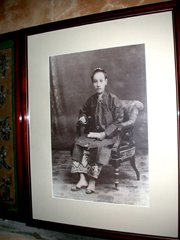
An old lady was walking around keeping the place clean. A little bent, she was a very friendly lady, offering explanations here and there. So, I took the opportunity to ask about the temple. I asked her how long she had stayed in this temple. She said that she was there since the age of 5 when her suhu (sifu - master) brought her there. She said that she's 84 years old and her name is Chua Peng Nyet. The suhu, whom she showed us from the picture, was a Peranakan Nyonya from Penang, Chew Nee Lock, who passed away in 1970.

She also showed us a picture of her suhu (sifu)'s suhu,Teh Chit Yee, a Teochew lady . The picture showed a more traditional Chinese picture, but she could well be another Peranakan.

The temple is very old and there are many artifacts of heritage value. I hope that they will be preserved and not thrown away unknowingly. (^^) There was a bell which indicated that it was made in 1908. The boards showing the donors were so old with age, or covered with soot that I could not make out the names. Interestingly, the lady told us that in November, a devotee actually donated a kind of chandelier to the temple!

There were many old statues that were kept in the temple and they were still being worshipped. From what I understood from the lady, some were abandoned and some were left behind for safekeeping by devotees whom the temple knew. Apparently, when a house is under renovation, the temple is a good place to place the statues of the Deities.

The lady kept asking if we would like to have tea. Ah, such hospitality is hard to find in temples these days. In the old days, or my younger days, when I used to walk the entire length of Mt. Faber, I would always stop by the temples. Why? They serve tea to the "weary travellers". (^^)