Saturday, February 28, 2009

26. Feng Huo Yuan 风火院

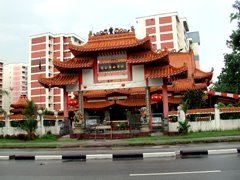
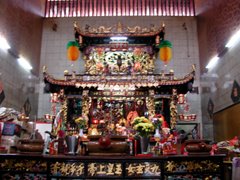
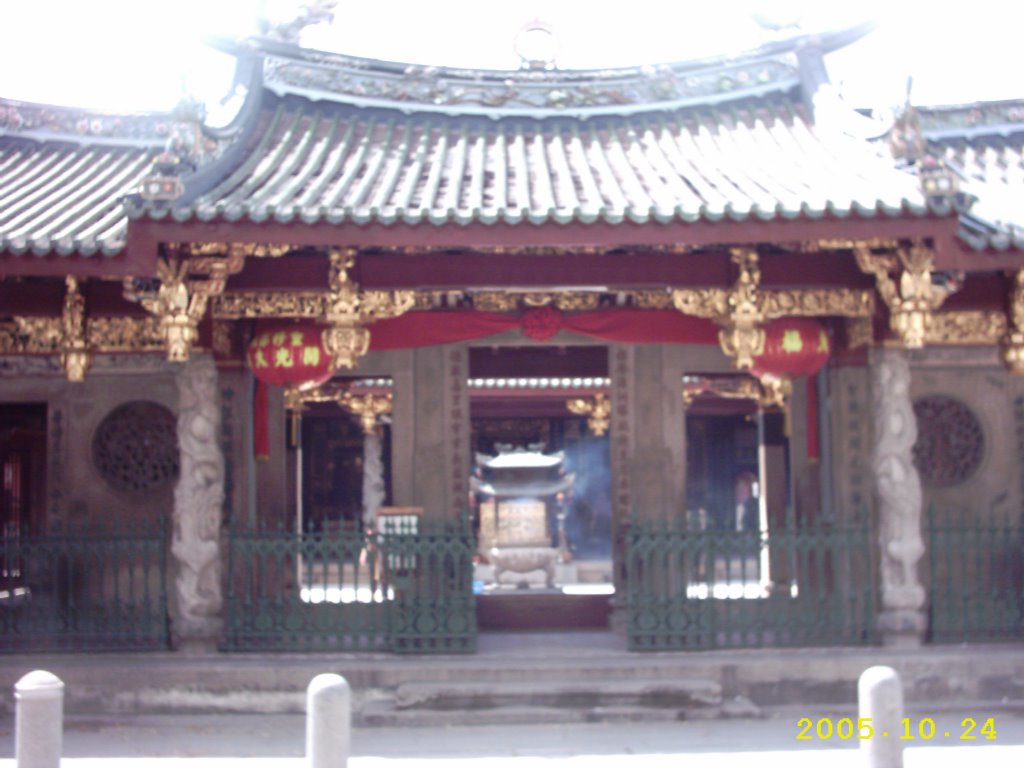
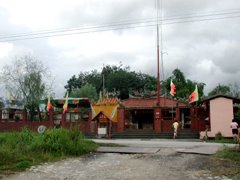
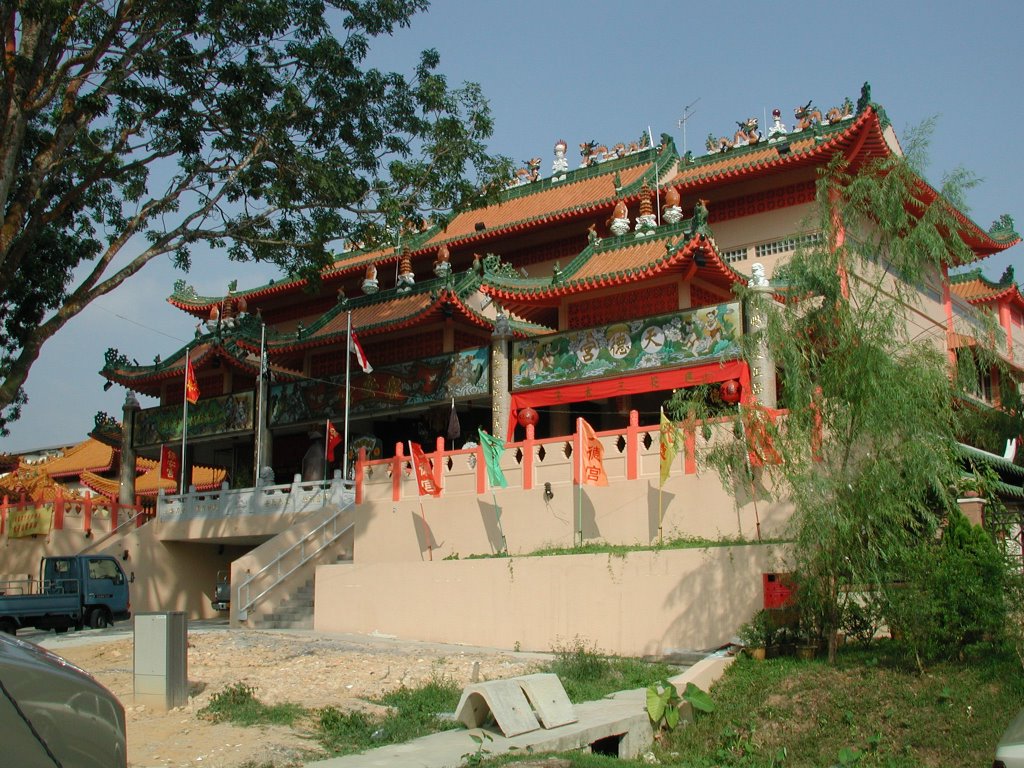
Nested in this lane, which is considered as part of Paya Lebar Road, are two temple complexes, all new generation temple buildings built as a result of urban renewal in Singapore.

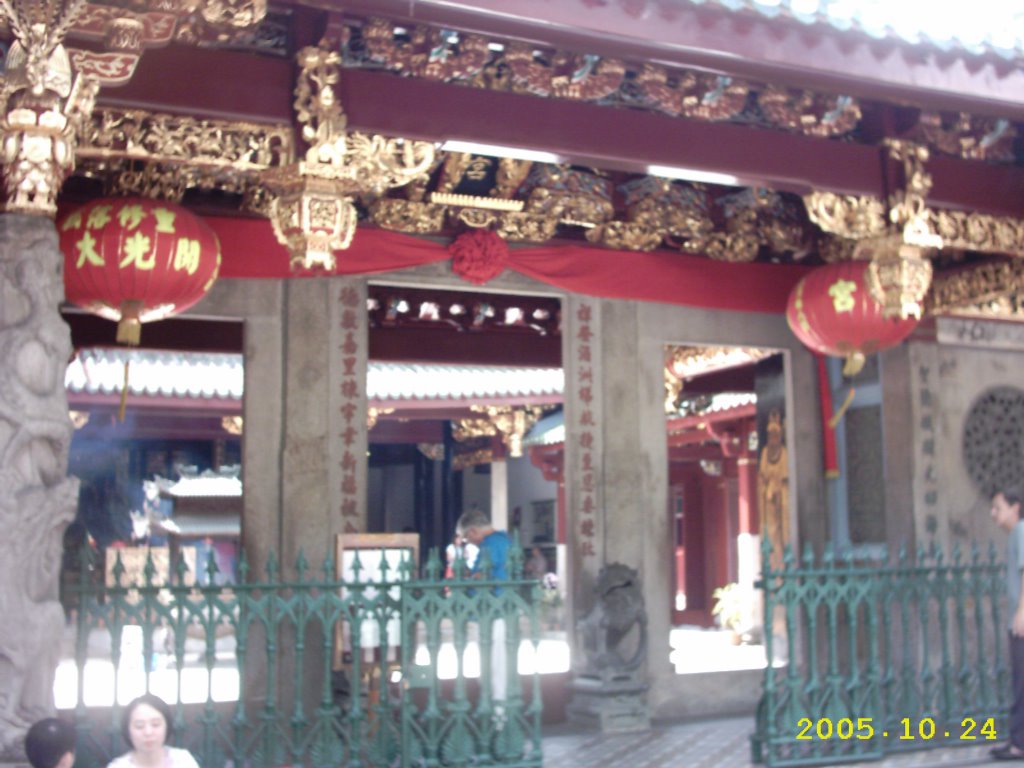
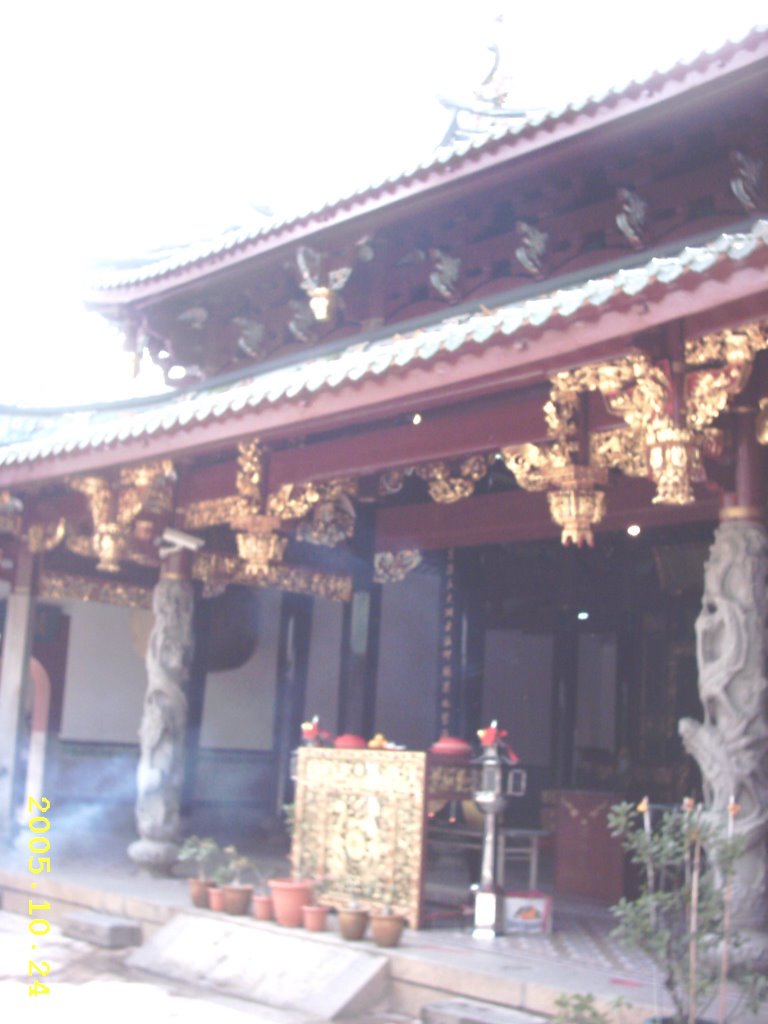
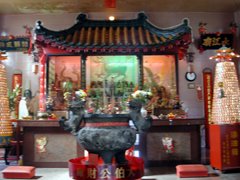
This is one of the two temples in this complex, Feng Huo Yuan 风火院. Interestingly, if you look at the name at the temple, you would see the word "Huo" (which is fire) up-side-down. It could be in the belief that if it is written this way, then the fire would not come alive!

I could remember long long ago when I first visited this temple (which was already built), an old man was sharing with me the stories of olden times, when it was still farm land in this area. Under the renewal programe, the small temple (probably in a hut or so) had to make way, but he told me that the main deity refused to move. And so, the devotees had to see how to keep the temple in its place. Alas I did not have the chance to follow up, but happy to note that till this day, this temple is still there. It probably still has a story to tell of the olden days with its neighbourhood forming the devoteeship.

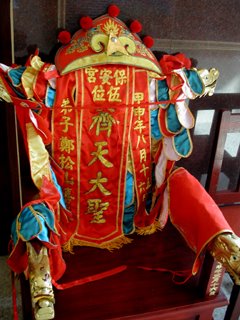
This temple is dedicated to, amongst the many Deities, Hong Jun Fa Zu 鸿钧法祖 (known to the Hokkiens as Ang Kun Huat Chor or Ang Kun Lor Chor). While there are a couple of such temples dedicated to Hong Jun Fa Zhu in Penang, Malaysia, in Singapore, it is rare.

This temple has an active group of members practising the tradition of the cultivated Tao. They even produce CDs of their chanting, to be given away free. You can get copies from the temple.

Tuesday, October 14, 2008

Nine Emperor Gods: Long Nan Dian sendoff

Long Nan Dian sent off Nine Emperor Gods in a rousing ceremony at the East Coast Parkway on 7 Oct 08 (9th day if the 9th moon).

There were nine palanquins in the send-off.


Friday, July 04, 2008

25. Jiu Xian Gong 九玄宫

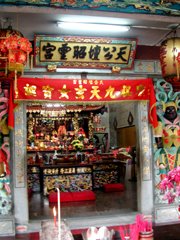
The Jiu Xian Gong 九玄宫, the shortened name for 九天玄女真仙。俗称玄女妈宫, started in 1928 by the Bai Clan at 7 milestone, Tampines Rd. In 1970, owing to rapid urbanisation, the temple started looking for a more permanent place for the temple. In 1982, a piece of land at Tampines Road was found and in 1985, the temple was built.
Many of the devotees and supporters of the temple are still from the Bai 白 Clan. Today, the temple stood tall at one end of the row of temples along the Old Tampines Road. Recently, further renovation to the temple was made.


This temple's main diety is Jiu Tian Xuan Nv 九天玄女. Jiu Tian Xuan Nv has a very long history and is well known amongst the Chinese people.

Monday, February 12, 2007

Second Book on Chinese Temples launched

The second book on Chinese Temples has been launched by Shin Ming Daily on 1 Feb 2007. Costing S$5 a copy, this book covering some 40 Temples are available in newstands and major bookstores.


Saturday, August 26, 2006

24. Jin Long Si 金龙寺

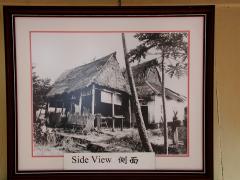
A temple that started off in an attap shed on a land donated by a grateful jeweller during WWII (1941), Jin Long Si, 金龙寺 (originally known as Jin Long Miao) was later rebuilt into a zinc-roof and wooden structure. It has since stood still with passing time. Today, this unique structure in the midst of rapid developments in the Lorong How Sun (off Bartley Rd & Upper Paya Lebar Rd) area, which is as busy as before, stood still in time, reminding us of the kampung days in this area and in Singapore.

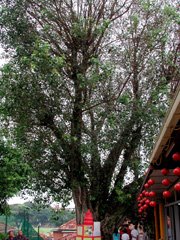
What is older than this temple is the Bodhi tree that probably has recorded the development or evolution of this temple with passing time and the generations of villagers and worshippers. It stands there, each day watching the worshippers pray or chants. As the 94 year old temple keeper shared her story, whenever she had time, she would come to the tree to meditate. This elder Bodhi tree is said to be about 100 to 120 years old.

Located in a very good fengshui point, this temple and tree have grown into a symbiotic relationship. This could not have been better described than by a father and son devotee of the temple. The tree reminds them of their late wife and mother, and the tree brings peace to them, as with the chanting inside the temple.

While this temple is now actively involved in Buddhist chanting, it is a san-jiao (three religion) temple with teachings derived from the great books of Buddhism, Taoism and Confucianism. The teachings of the late master continued to be shared with the devotees each Sunday afternoon through a tape player.

This temple also has many unique Taoist Deities like Nan Wu Wu Ji Sheng Mu and Pan Gu. There must be something in this temple that inspires the artistic talents of the devotees. In the short history of the temple (65 years), the devotees had made a huge statue of the Laughing Buddha out of saw dusts (similar to those used for making joss sticks), built a pagoda and also a pavilion with the life size statue of Nan Wu Wu Ji Sheng Mu.

Devotees of the temple get to take vegetarian meals after the chanting. The vegetarian dishes were created and cooked with such loving care that they are probably the best secrets kept in Singapore. No money can buy. (^^)

At this moment, this temple is in danger of disappearing soon. The Buddhas and Deities willing, it might be a short time left for anyone to enjoy (appreciate) one of the last remaining bastion of rural Singapore temple.

The place: Jin Long Si, Lorong How Sun

Sunday, July 16, 2006

23. Seng Wong Beo 都城隍古庙

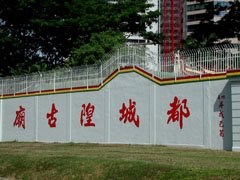
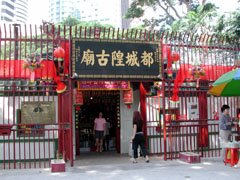
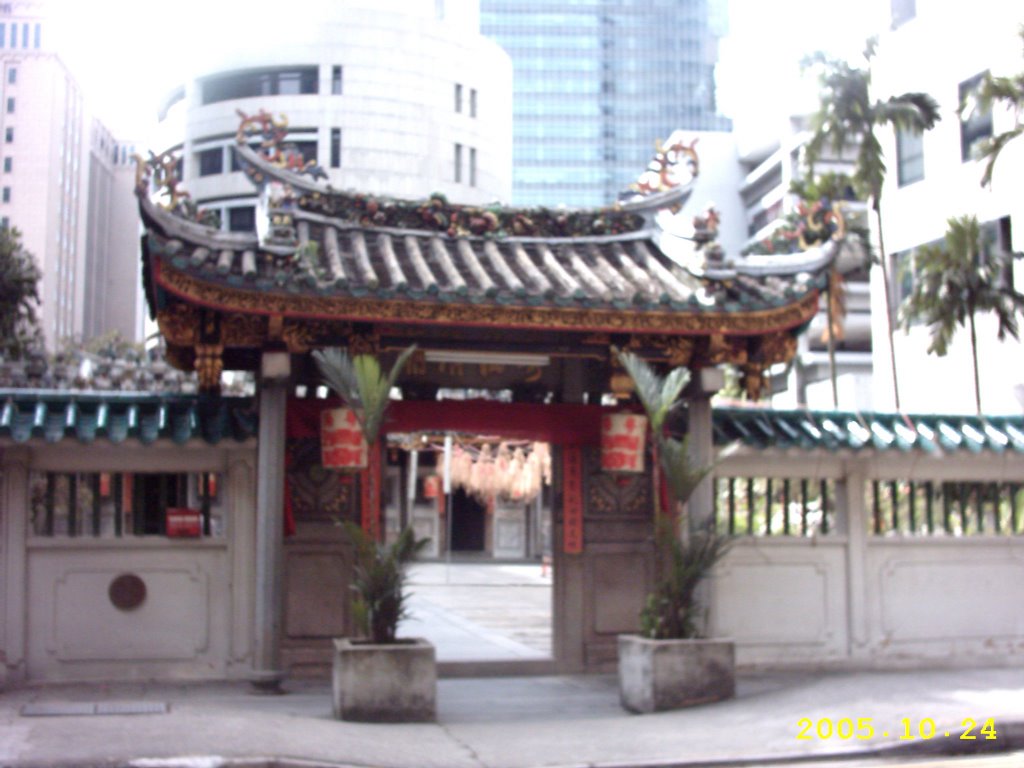
Seng Wong Beo, as is more popularly known to the older generations in Singapore, was a landmark in Tanjong Pagar. It is still a landmark, an ancient structure dwarfed by the huge and tall concrete skyscrapers. This year, 2006, it celebrates its 101st year of existence.

Painted with both strokes of the Chinese brush style on the exposed outside wall of this temple is Du Cheng Huang Gu Miao 都城隍古庙. Cheng Huang is translated as City God in English.

This temple has an interesting history. It was founded by a Buddhist monk although the temple is more Taoist in nature. It can be considered as a syncretic temple, which is quite common in the Chinese temples in the early days of Singapore.

This temple is also well known as the temple where ghost-marriages are arranged. According to sources, sometimes, a family member of a deceased relative (single who died young) might have a dream about being requested to arrange a marriage for the deceased. Chances are it would be the mother who dreams about it. In about the same time, another family might have a similar request. This temple does "match-making" too, matching them according to the descriptions. This is but one aspects. The SPI website has a more detailed report on this.

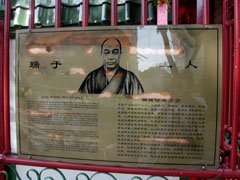
Below is an interesting account which was posted on a signage outside the temple, explaining on the history of the temple.

Seng Wong Beo Temple

The temple was founded by Reverent Swee Oi from China. The Reverend whose family name was Huang, was educated and well versed in poetry. He was an imperial scholar during the Qing dynasty. However his keen interest in Buddhism led to his decision to become a monk. He was ordained in Fuzhou Quanzhou.

He later came to Singapore where he saw many Chinese who sailed in boats from China and settled mainly in the Tanjung Pagar and Telok Ayer areas. They worked mostly as labourers in the harbour and also as rickshaw pullers. Their life was hard. Falling ill and feeling lonely and home-sick were common. Their hardship touched Reverent Swee Oi who then decided to build a temple in Tanjung Pagar. He wanted these people to have a place where they can worship and pray for the well-being of their loved ones back home in China.

The temple was first built in the 31st year of the Qing Emperor Guang Xu's reign. Two years later, the then Chinese Consul to Singapore, Zuo Bing Long, personally wrote a tablet and presented it as a gift to the temple. The tablet still hands in the main prayer hall of the temple.

The temple worships the City God. According to Chinese beliefs, the City God guards the city from evil. Devotees come to the temple to pray for the country's peace and prosperity, for the triumph over evil and for the good health of all. The City God rewards good deeds and punishes the evil ones. He also has the responsibility to guide souls of the dead to the underworld. His temple has ben and continues to be a place of solace for its many devotees.

Saturday, May 20, 2006

22. Tian Gong Tan Zhao Ling Gong 天公坛昭灵宫

There are three temples in the Jurong West Combined Temple 裕廊西聯合宫 [Yu Lang Xi Lian He Gong] located at the corner of Jurong West St. 41 and 51. Looking at the front of the temple, from the left, West Coast Hock Teck Si (Xi Hai An Fu De Ci 西海岸福德祠), Tian Gong Tan Zhao Ling Gong 天公坛昭灵宫, and Xian Long Gong 显龙宫.

In this report, I shall just focus on Tian Gong Tan Zhao Ling Gong.

Tian Gong Tan Zhao Ling Gong 天公坛昭灵宫 has a plaque that briefly described the temple's history and how it was originally merged between the Tian Gong Tan 天公坛 and Zhao Ling Gong 昭灵宫. Reproduced below, with some additions from the Chinese version, is the temple history from the temple's plaque.


Tian Gong Tan Zhao Ling Gong Temple"Tian Gong Tan" was a wooden temple erected [in 1917] by the villagers for the worship of "Tian Gong 天公" and "Qian Shou Guan Yin 千手观音" as well as celebrating "The Hungry Ghosts Festival 中元节" in the 7th Lunar month. it was located at Clementi Park along Sunset Grove.

"Zhao Ling Gong" worships the "Jiu Tian Xuan Nu 九天玄女" and "Zhu, Xing, Li Da Ren 朱,邢,李大人". It was migrated to Singapore from China, Fujian, Anxi province [Gong De Li 公得里(Neighbourhood) Ma Tou Xiang 马头乡(Village) with Mr. Koh 许 (Xu) in the 1930's. After several settlements, it was last settled in Clementi Park. Mr. Koh performed as the Medium and the prayers was carried out in his house. The villagers believed the Holy spirits of "Jiu Tian Xuan Nv" because they will have a peace of mind after the prayers. In order to have a more convenient and comfortable place of worship, the villagers and Mr. Koh came to a concensus in 1943 that the deities of "Zhao Ling Gong" joined "Tian Gong Tan". [In 1975, they started the first management committee, celebrating the Tian Gong's birthday on the 9th of 1st lunar month, celebrating the birthday of Jiu Tian Xuan Nv on 15th of 4th lunar month and the Hungry Ghost Festival on 1st of the 7th lunar month.]

In 1983, the temple site was affected by resettlement and was ordered to move by the Authorities. The villagers and enthusiastic believers formed a Preparatory Committee in 1988 with the name of "Zhao Ling Gong" to raise funds and activities were carried out for about five years to raise the funds needed.

On 28 Feb 1992, the Preparatory Committee jointly bought a piece of land from HDB Land Office, with Shan Leng Temple and West Coast Hock Teck Si, which is located at Jurong West St 41 (current location), 1800 m2 in area for a term of a 30 year lease. The construction of the new Temple commenced on 14 Mar 1993 and was completed after two years.

In 1993, with the name of "Tian Gong Tan Zhao Ling Gong" Temple, the committee applied for registration as a legal society. The application was approved in 1994.

The deities entered the new Temple on 30 Oct 1996.

The main events of the Temple:
(1) Tian Gong's birthday: 9th day of the 1st Lunar month
(2) Jiu Tian Xuan Nu's birthday: 15th day of the 4th Lunar month
(3) The Hungry Ghost Festival: 1st day of the 7th Lunar month

Friday, March 10, 2006

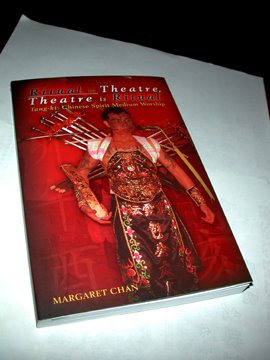
Book: Ritual is Theatre, Theatre is Ritual

This book: Ritual is Theatre, Theatre is Ritual: Tang-ki: Chinese Spirit Medium Worship by Margaret Chan is probably the first English edition book on Tang-ki worship in modern day Singapore. This book is also a Tangki Worship 101 for many who might have witnessed numerous such events in Singapore and yet have no idea on what they were all about.

This book is both for those "inside" and those "outside". Many Singaporeans probably have a hard time explaining to their foreign friends about this interesting and colourship worship. Tang-ki worship is also very much an oral tradition, where knowledge is passed down from grandparents to grandchildren, and much detailed information has been lost. So, this book is certainly timely, especially for present day kids and adults alike who are asking to understand and know more about what their grandparents and parents have been and are worshipping.

Certainly a good guide book for one to read before and after attending a temple event where there are tang-kis (spirit mediums). This book is now available in all major bookstores in Singapore.

Ritual is Theatre, Theatre is Ritual
Tang-ki: The Chinese Spirit Medium Worship
By Margaret Chan

Published by
Wee Kim Wee Centre
Singapore Management University& SNP International

ISBN : 981-248-115-X
Bookshop Price: S$39.90

Saturday, March 04, 2006

Fire Dragon 火龙 at Man San Fu Tat Chi 万山福德祠

The Fire Dragon 火龙 is another form of the more commonly seen and known Dragon, which is usually made of cloth material. The Fire Dragon (Huo Long) is made from straws from the padi (also known as Straw Dragon or Tau Chao Long 槄草龙). In Singapore, it is said that only the Man San Fu Tat Chi 万山福德祠 (or Wan Shan Fu De Ci in Mandarin) in the Sar Kong (Sha Guang 沙冈) village - which is now just recognised as Sims Drive - has this Fire Dragon as part of its traditional temple event.

It is in fact quite rare to see such a dragon and the performance with this dragon. So, it was fortunate for me to be able to witness this interesting event. I think we can say that this is a Cantonese tradition. This year, on the 2nd of 2nd Lunar Month, the temple celebrates the birthday of Tu Di Ye Ye with this Fire Dragon, 6 lions and a three-day Cantonese Opera from Hongkong.

Some 3 months before this date, the only expert in Singapore started making the Fire Dragon with padi straws imported from China. He had to make parts of the body hard with these straws to allow sticking of the bigger than usual joss-sticks, and flexible ones to link between sections of the body. The head and the tail are probably the more difficult ones. It is another form of art. And for the performers, this would still be slightly different compared to the normal dragon.

The event started with temple members and devotees lighting the big joss sticks and stick them firmly onto the head, body and tail of the dragon. The 88 metre long dragon must have had hundreds of joss sticks stuck in its body. There was also the pearl ball which is also stuck with joss sticks.

After the ceremonly of bringing the dragon to "alive" by marking the vital parts of its body by the guest of honour, the dragon came alive. Under the able hands of the leader and troupe members, it was awesome the way the dragon floated in the air, twirling and swirling in the tight courtyard. On the dim road the dragon radiated its lights from each and everyone of the joss sticks stuck on it and the smoke gave an impression of the dragon cruising amongst the clouds. The occasional rubbing of the body gave rise to "sparks" adding on to the sparkles of the dragon.

After a walk along the "kampung" (village), the dragon came back to the temple and after paying its final respect to the Deities, was put to rest outside the temple. Here, they waited and let the joss sticks bring flame to the dragon, sending it off to the heavens with all the ills posted by the devotees. Indeed, over half an hour or so, the dragon was engulfed with flames and to the cheers of "Huat ah, huat ah", the smokes went up as the ashes fell down. An event that not many Singaporeans are even aware of. (^^)

Thursday, February 23, 2006

21.Thian Hock Keng Temple 天福宫 (Temple of Heavenly Happiness)

Claimed to be the oldest and most important Hokkien temple in Singapore, this place of worship houses a number of relics, some reputed to be several centuries old, which have been brought over from China. It was gazetted as a national monument on 6 July 1973. Thian Hock Keng has undergone several renovations, the latest in 1998.


Completed in 1842 to replace a simple joss-house built some two decades earlier, not a single nail had been used in the construction, not even for its pagoda-shaped roofs. Instead the entire structure is supported by iron-wood posts and granite imported from China. The temple boasts of gilded carvings, tile roofs adorned with dragons and phoenixes, intricate sculptures from China, pretty blue porcelain tiles from the Netherlands, and cast-iron railings from Scotland. The early builders understood well the significance shapes play in temple architecture, and the Thian Hock Keng is a fine example. It has windows that are circular to symbolize heaven, square to symbolize the earth, and tiles which were meticulously laid out either in square patterns to symbolize the mouth, implying that one would never go hungry here, or in an upside down “V” pattern, symbolizing “ren”, the Chinese word for “men”, to suggest that one can regard this place as a sanctuary.


According to Geraldene Lowe in her book, “Chinatown Memories”, some materials used in the construction of the temple had been salvaged from junks plying between China and Singapore. Crockery broken during the rough journey were recycled too, turning up as mosaic pieces adorning the feathers of birds, petals of flowers and on other ornaments dotted throughout the temple.


Tan Tock Seng who contributed $3,0474.76, then a princely sum, for the temple building fund, topped the donor’s list. This information, along with that on the founding of the temple, are inscribed on plaques installed near the main entrance.

Guarding the majestic entrance to the temple are two stone lions. The female one holds a cup representing fertility while her male counterpart holds a ball, symbolizing abundance. Before entering the temple, a devotee has to cross a rather high threshold. This is deliberate. For one thing, it forces him to cast his sight downward, an expression of humility, as is expected when one enters a sacred building. Another purpose is to keep out wandering malevolent spirits – it is believed that ghosts shuffle when they move, so this threshold was placed to trip them up. The more pragmatic would explain that the threshold is keep flood waters at bay, since the area was susceptible to flooding.


One of the main deities in the Thian Hock Keng is Mazu (Goddess of Seafarers/Patron of Sailors). She is accompanied by her two sentinels, one with vision that spans 1,000 miles and another gifted with ears that could hear 1,000 miles away. Years before the land in front of Telok Ayer basin was reclaimed and named Collyer Quay, Hokkien immigrants would step out of their junks somewhere behind Telok Ayer Street, possibly very close to the Ying Fo Kuan, a Hakka Association Hall established in 1822. Fresh off the boat, these chaps would invariably head for a “joss house” to give thanks to the Gods for their safe arrival after a long journey across the treacherous South China Sea. That was how the joss house at Telok Ayer Street, precursor to the Thian Hock Keng, came to be erected.

An exquisite likeness of Mazu was said to have been brought to Singapore from Amoy (Xiamen) in 1840. An elaborate procession was held that day as the Goddess made her way from the waterfront to grace the then newly-completed temple in Telok Ayer Street. Several other deities are worshipped in the Thian Hock Keng, among them Confucius, the God of Wealth, the God of Health, the Goddess of Mercy, the Sun God and the Moon Goddess.


Two pagodas flanked the Thian Hock Keng – the one to the right, nearer to Boon Tat Street, is said to contain ancestral tablets of a group of Hokkiens from the same village in Amoy who had landed in Malacca. Those men continued to keep in touch with each other after settling in Singapore. Today some of their male descendants still carry on this tradition of holding reunions, opening up the shrine on the eve of Chap Goh Meh, Cheng Beng Festival and Hungry Ghost Festival. The other pagoda nearer to Amoy Street had been the kindergarten section of a girl’s school in the 1970s. It has now been converted into a café cum souvenir shop. The two pagodas have very striking roofs – they are red and shaped like a gourd. The significance of the gourd-shape is explained at length in Geraldene’s book. She wrote that before glass and porcelain had been invented, medicines were stored in gourds which had been left to dry. As such, gourd-shaped talismans worn on the body were believed to have the power to protect its wearer from diabolical forces out to wreak havoc on one’s health. Eventually some temple roofs took on this shape too – to indicate that there is a herbalist or physician on site. Perched high above other buildings, and with such a striking colour, it was easy for people to spot such a temple.

Thian Hock Keng is managed by the Hokkien Huay Kuan (Association for the Hokkien dialect group), located just across the road. Originally, this dialect association was housed in the temple itself. Tan Tock Seng’s son, Kim Cheng, was the association’s pioneer President. During his tenure, the temple cum huay kuan was the focal point of the Hokkien community, serving not only as a place of worship, but also as a meeting place for the community, a recruitment centre for coolies as well as a safe-house from unruly elements.


Location:
158 Telok Ayer Street
Singapore 068613
Tel: 6423-4616; 6222-2651

Saturday, February 11, 2006

20. Wan Shou Shan Kun Cheng Tang 万寿山堃成堂

For more than 40 years, I passed this temple, first by walking up the path to Mt Faber, and later driving past, but I did not get to visit the temple until December 2005. From a temple with a great fengshui with a hill behind with lots of trees and nothing else, and looking down the valley or foothill with the attap houses, this temple is now dwarfed by the surrounding HDB flats.

There are actually two temples in this complex. This one at the lower level, is the Wan Shou Shan Kun Cheng Tang 万寿山堃成堂. Both temples are dedicated to the 18-Hand Guan Yin, with many other Deities as well.

From the main signage above the door, it was crafted in the year Guang Xu 光绪 6 year, that is the 6th year of the reign of Emperor Guangxu (Kuang Hsu). This penultimate Qing emperor ruled China from 1875 to 1908 - hence that would make the date of establishment of this temple, 1881. This would make the temple about 125 years old. The structure looked neo-modern with tiles of the Peranakan age.

An old lady was walking around keeping the place clean. A little bent, she was a very friendly lady, offering explanations here and there. So, I took the opportunity to ask about the temple. I asked her how long she had stayed in this temple. She said that she was there since the age of 5 when her suhu (sifu - master) brought her there. She said that she's 84 years old and her name is Chua Peng Nyet. The suhu, whom she showed us from the picture, was a Peranakan Nyonya from Penang, Chew Nee Lock, who passed away in 1970.

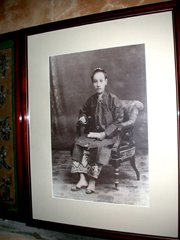
She also showed us a picture of her suhu (sifu)'s suhu,Teh Chit Yee, a Teochew lady . The picture showed a more traditional Chinese picture, but she could well be another Peranakan.

The temple is very old and there are many artifacts of heritage value. I hope that they will be preserved and not thrown away unknowingly. (^^) There was a bell which indicated that it was made in 1908. The boards showing the donors were so old with age, or covered with soot that I could not make out the names. Interestingly, the lady told us that in November, a devotee actually donated a kind of chandelier to the temple!

There were many old statues that were kept in the temple and they were still being worshipped. From what I understood from the lady, some were abandoned and some were left behind for safekeeping by devotees whom the temple knew. Apparently, when a house is under renovation, the temple is a good place to place the statues of the Deities.

The lady kept asking if we would like to have tea. Ah, such hospitality is hard to find in temples these days. In the old days, or my younger days, when I used to walk the entire length of Mt. Faber, I would always stop by the temples. Why? They serve tea to the "weary travellers". (^^)

Thursday, January 05, 2006

19. Jalan Kayu Ban Kok Sua Chong Yee Temple 万国山忠义庙

This present Jalan Kayu Ban Kok Sua Chong Yee Beo [Wan Guo Shan Zhong Yi Miao] 万国山忠义庙, has been at this place since 1964. The main Deity of this temple is Guan Gong, known as Hup Tian Dai Deh [Xie Tian Da Di 协天大帝]. The Guan Di statue was actually from the Guan Di temple in Dong Shan 东山, Fujian. This temple was said to be the springboard for the Guan Di temples in Taiwan, and possibly South East Asia.

After the statue was brought from Dong Shan, it was placed in the Guan Di temple in Paya Lebar, called Chai Shan 柴山. In the 1950s, a group of elders started building a temple, an attap hut, in Jalan Kayu. It seems that this place was called Man Kok Sua [Wan Guo Shan 万国山] In 1962, efforts to rebuild the temple were made and it was built in 1964.

On the land where the attap hut temple was built, it was said that during the old days, there was an angmo, who probably owned this land, and he was ill. He consulted the Guan Di through the medium and was cured. In return, he gave the land for them to build the temple.

In 1984, a new executive committee started recruiting members for the temple, and each year in the Lunar Calendar of 3rd month and 6th month, the temple celebrates the birthday of Xie Tian Da Di 协天大帝 and Xuan Tian Shang Di 玄天上帝 and other Gods

In the old days, the temple was surrounded by farmlands and villages. Now, most of these are gone. But the former residents still come back to the temple, especially during the festive days.

The temple is now raising funds, expecting to move to a new site in the near future. It is now one of the few remaining kampung (village) temples with the timeless village atmosphere.

Jalan Kayu Wan Kuo Shan Zhong Yi Miao
374L Seletar West Farmway 6
Off Jalan Kayu
Singapore 798039
Tel: 6483-2401

Consultations:
Xie Tian Shang Di 协天大帝:
Every Wednesday and Friday, 1st and 15th of Lunar Month, from 2pm
Da Er Ye Bo 大二爷伯, Bao Gong Da Ren 包公大人:
Every Friday, 1st and 15th of Lunar Month, from 8pm

Celebrations:
Jade Emperor: 9th Day of First Lunar Month
Xuan Tian Shang Di玄天大帝 : 5th-7th of 3rd Lunar Month
Xie Tian Da Di 协天大帝: 10-12th of 6th Lunar Month
Da Er San Ye Bo 大二三爷伯: 11th of 4th Lunar Month

Sunday, December 18, 2005

18. Chwee Kang Beo 水江庙


By the side of the Kallang River is a temple, known in Hokkien as Chwee Kang Beo, or Shui Jiang Miao in Mandarin, 水江庙.

This temple is dedicated to the Stone Lion City God. There are four main Deities in this temple, Shi Shi Qi Wang Ye 石狮七王爷, Shi Shi Cheng Huang Gong 石狮城隍公, San Jiang Da Pu Gong 三江大普公 and Da Bo Gong 大伯公.

The celebrations for Shi Shi Qi Wang Ye and Shi Shi Cheng Huang Gong is on the 28th of 5th Lunar Month. For San Jiang Da Shan Gong and Da Bo Gong, it is 15th of 11th Lunar Month.

In the temple, there was also the Horse General at the side of the main building. Next to the Tiger God's cave is a boat.

From a report in the Shin Ming Daily, 4 July 2005, Monday (Page 7), there was an interesting story from this temple, from which I did a rough translation:

Shui Jiang Miao 水江庙 celebrates in honour of Stone Lion City God (Shi Shi Cheng Huang Gong 石狮城隍公) and the Seven Lords (Qi Wang Ye 七王爷)

The main Deity of Shui Jiang Miao (Chwee Kang Beo in Hokkien) is Da Pu Gong 大普公. The Shi Shi Sheng Huang is also equally famous and has been in the temple for the past 40 years.

Every year, on the 27th to 29th of 5th Lunar Month, the Shui Jiang Miao celebrates in honour of Shi Shi Sheng Huang Gong and Qi Wang Ye.

The Qi Wang Ye are good assistants to the Sheng Huang. In the Sui Jiang Miao, only the Qi Wang Ye could be consulted through the medium. For the rest of the gods, they communicate through the sedan chair.

The story of the Stone Lion Sheng Huang in Shui Jiang Miao goes like this. In 1965, a old worshipper went to Stone Lion (Shi Shi 石狮), Quan Zhou 泉州, Fujian 福建, brought back a statue of Cheng Huang and wanted to have it consecrated (kai-guang 开光) before bringing home. When the medium was about to kai-guang, the Sheng Huang (appeared in the medium) wanted to remain in the Shui Jiang Miao. So, the worshipper left the statue in the temple. That's how the Stone Lion Cheng Huang stayed in the temple. As the Sheng Huang was originally a water-ghost, he probably would like to stay in this temple which is by the waters.

Wearing the Yellow Robe, the Water-ghost becomes the City God

Legend has it that once there was a water-ghost looking for a body to take over so that he could be reincarnated. He found a person with good features, but upon checking on his future, he found that this person had a very good fortune. He would become a uncorrupted official. He decided not to take over his body but to live in his body. He followed him and took care of him.

A few years later this person passed the imperial exam and become an imperial official -Zhuang Yuan 状元. One day, the Emperor called him up and took a liking to him. He offered him a seat and tea. When the person wanted to drink his first mouthful, he remembered the water-ghost who had protected him all the way. He threw the tea behind the door for the water-ghost to drink first. When the emperor noticed his unusual act, he asked for the reason. He was told about the water-ghost who was hiding behind the door. The Emperor wanted to see the ghost but was told that he had no clothes on and dared not come out. The Emperor then took out his robe and asked the water-ghost to wear it and come up. Hence the water-ghost became the Cheng Huang.


Interesting note:
I was told that the Cantonese has this phrase to illustrate a person who tries to be someone big: Shui Gui Sheng Cheng Huang (水鬼升城隍)Shui Kuai Sing Seng Wong (Cantonese). Anyone heard of this? (^^)

This temple was built and opened on 22 December, 1999.

The address: 801 Upper Boon Keng Rd, Singapore 387310
Tel: 6748 9782
Fax: 6749 4297

Tuesday, December 13, 2005

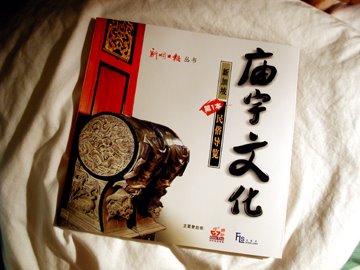
Book: Chinese Temples in Singapore 庙宇文化

On 8 Dec 2005, Shin Min Daily, a local Chinese Newspaper in Singapore launched its first book on Chinese Temples in Singapore, Miao Yu Wen Hua 庙宇文化. This book covers some 38 temples in Singapore. The book is available in most bookshops and newspaper stands at S$5 each.

This book, written in Chinese, gives the readers a glimpse of the Chinese temples in Singapore and their history. A couple of the reported temples are already more than a hundred years old.

Wednesday, November 30, 2005

17. Wak Hai Cheng Beo (Yueh Hai Ching Temple) 粤海清庙


Reputed to be the oldest temple established by the Teochew community in Singapore, this building came under the management of the Ngee Ann Kongsi, a Teochew association, in 1845. It was gazetted as a national monument in 1997.


A large part of the temple was constructed with rosewood imported from China. Intricate designs of Chinese legendary figures can be found on the walls and eaves of the building. There is even a wooden plaque presented in 1907 by Emperor Guang Xu of the Qing dynasty hanging in the temple.

Although the temple is centuries-old and showing signs of wear-and-tear, it still attracts a sizeable number of devotees and tourists, many of whom would marvel at the majestic courtyard and the fine craftsmanship evident throughout the building. No photo-taking is allowed inside the temple.

The temple has two halls - one devoted to Tian Hou Gong (left, as you walk towards the temple) and the other to Shang Di Gong (on the right). Among the deities at the Tian Hou Gong is Zu Shen Niang Niang, a goddess favoured by couples hoping for a child and parents seeking blessings from the goddess for their children. The main deity, however, is Tian Hou Sheng Mu (Ma Chor/Mazu/Goddess of the Sea/Heavenly Mother). To her right is Long Wei Sheng Wang and on her left is Gan Tian Da Di.

At the Shang Di Gong, the main deity is Xuan Tian Shang Di (Heavenly Father) and in front, to his left, is the Tai Sui.

The temple sees many devotees on the 1st and 15th day of the month, as well as on the 3rd and 23rd day of the third lunar month, when the birthdays of the Heavenly Father and Heavenly Mother are celebrated. Some devotees would buy the “pyramid” joss stick (the Hokkiens call it “pagoda” joss-stick), paste their name inscribed on a piece of red paper onto the joss-stick, then hand it to the temple official to hang in the courtyard.


On the eve of Chap Goh Meh (15th day of the first lunar month), crowds can be expected. Extra containers would be placed around the courtyard for devotees to burn their offerings. The heady scent of sandalwood emanating from the lighted pagoda joss-sticks above would fill the night air. At the hall of the Tian Hou Gong, flags and lanterns would be placed on the altar. Devotees wishing to bring these objects of veneration home would have to seek the Gods’ favour by tossing two kidney-shaped divination blocks. Only if consent is granted could they bring either object back, and the devotees would also equip themselves with joss-sticks which have to be kept alight throughout the journey. Thus some devotees would bring along extra sets of joss-sticks as replenishment, or simply carry an extra long one.

Another major celebration at the Wak Hai Cheng Beo takes place towards the end of the year when thanksgiving prayers are made to the Tai Sui and Confucius. A set of prayer paraphernalia (comprising a big bundle of joss-paper and 3 joss-sticks) costs S$6.00 for the Tai Sui and S$2.50 for Confucius (a smaller bundle of joss-paper and 3 joss-sticks).

The statue of Confucius, depicted here as a mandarin with a bushy black beard and holding an ancient booklet, is just in front of Xuan Tian Shang Di. He is a favourite with school-children – one by one, the children, holding their bundle of joss-paper and joss-sticks, would kneel before Confucius as the temple official chants a prayer in Teochew. That done, the child would plant the joss-sticks at Confucius’ altar before consigning the joss-paper, on which their name and school had been written, to the flames. In return, the children would be presented with a pencil, exercise book and ruler, and the blessed assurance of Confucius.

Location:
30B Phillip Street
Singapore 048696

Thursday, November 17, 2005

16. Poh An Keng 保安宫


This temple was consecrated in 2004, a temple dedicated to the five Monkey Gods. Unknown to many, this temple was originally in a old pre-war shophouse at Peck Seah Street, diagonally across from the Seng Wong Beo. This temple was already there in the 1950s.

Since it moved out from Peck Seah St, it has gone to more than one or two places before finally settling into this new temple building, shared with two other temples. Thanks to a generous benefactor, who wanted to repay the kindness of the Monkey God, the medium and temple who help his mother and family when they were poor, this new grand temple was possible.

The medium then was the grandfather of the current medium.

This temple is along Tampines Road.

Sunday, November 13, 2005

15. Fu De Tang 福德堂


Diagonally across to the Geok Hong Tian along Havelock Road, is a small Fu De Tang 福德堂 standing quietly (next to Meinhardt), almost unnoticeable!

An old lady keeper of the temple said that "it's more than 80 years old." When we asked about the name, she said that long ago, someone went to Kusu Island to bring the "joss-fire" to set up the temple here as many could not make the small boat trip to Kusu Island, hence the name Gui Yu Da Bo Gong 龟屿大伯公 (Kusu Tua Pek Kong). In those days, probably there's no big motorised boats. (^^).

She said that the Kusu Island Da Bo Gong is more than a hundred years old.

Tuesday, November 01, 2005

14. Kusu Island Temple 龟屿大伯公.


There is a Chinese temple and a Malay shrine on this 85,000 square metres island (about the size of 13 football fields) located 5.6 km south of the main island of Singapore. To reach it, you have to board a ferry from Sentosa ferry terminal. The boat trip takes about 45 minutes one-way, and a round trip costs S$9 for an adult and S$6 for a child (3 to 12 years). The Sentosa admission charge is waived for visitors who buy the Kusu Island ferry ticket upon entry. No overnight camping is allowed on Kusu Island unlike the nearby St John's Island.

“Kusu Island” means “Tortoise Island” in Hokkien. Other names have been associated with this island too, among them Peak Island, Governor’s Island and Pulau Tembakul. There are several legends on how Kusu Island was so named. One popular tale is that of a tortoise transforming itself into an island to save two shipwrecked fishermen, a Malay and a Chinese, who had earlier rescued it from the Lau Pa Sat market. The fishermen had noticed tears dripping from the tortoise’s eyes, and decided to buy it, and then released it back to the sea. They did not know that it was an enchanted tortoise until its extraordinary manifestation during the storm. Out of gratitude, the two fishermen returned the following year to make offerings on Kusu Island. Soon other people followed suit.

At the time of writing, the Chinese temple on Kusu Island is looked after by Mdm Sim Chwee Eng, a 76-year old widow, and her 57-year old son, Seet Seng Huat. The Seet family has been taking care of the temple for the last five generations. They used to live in an attap hut on the island. Over the years, this has been upgraded to a brick and mortar dwelling next to the temple. How did this responsibility fell on the family? According to Mdm Sim, her husband’s ancestors were boatmen and fishermen. They used to seek shelter on the island during inclement weather - there is a Tua Pek Kong (God of Prosperity) statue on their boat. One day, the Tua Pek Kong spirit entered his ancestor and disclosed that he wanted to reside on Kusu Island. Complying, the ancestor built a modest shrine there.

By and by, more people came to know of this Tua Pek Kong and one man who used to be a bullock-cart puller, became wealthy after praying to this deity. This was probably during the 1920's. He had promised to upgrade the shrine, but did not do anything about it until the Tua Pek Kong reminded him, in a dream, of the pledge he had made.
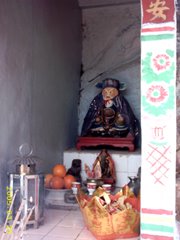
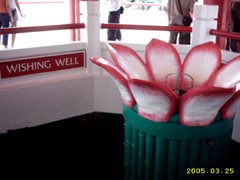
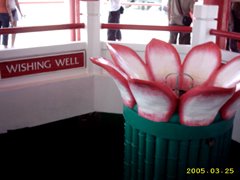
Before 1975, boats would berth right at the doorstep of the temple. Land was reclaimed in 1976, and now the jetty is some distance from the temple. The temple housed seven types of deities - besides Tua Pek Kong who occupies the central altar, there are the Jade Emperor; Goddess of Mercy; Eight Immortals; Kuan Kong (God of War); Tai Seng Yah (Monkey God); and the Tiger God/s. Now there is even a wishing well on the compound leading to the temple - where visitors are encouraged to make a wish, toss a coin which hopefully will hit one of the bells inside the well, ringing in the good luck sought.
There are two pythons caged up in the temple, as well as two ponds containing tortoises. According to Mdm Sim, many tortoises were released here by members of the public so she has no choice but to do what she could to feed and housed these creatures, at her own expense.

There is a food complex built between the temple and the Keramats’ (holy men/women) shrine. But this food centre only comes alive during the Kusu pilgrimage season during the Chinese 9th lunar month when about 120,000 devotees would converge on the island. Hence at other times, visitors who are hungry can order simple dishes such as a plate of fried vermicelli from Mdm Sim, at S$10 per plate. On a typical weekday, only about twenty visitors, mostly tourists, would visit the island.

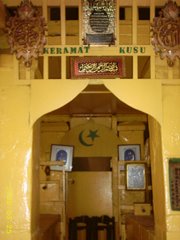
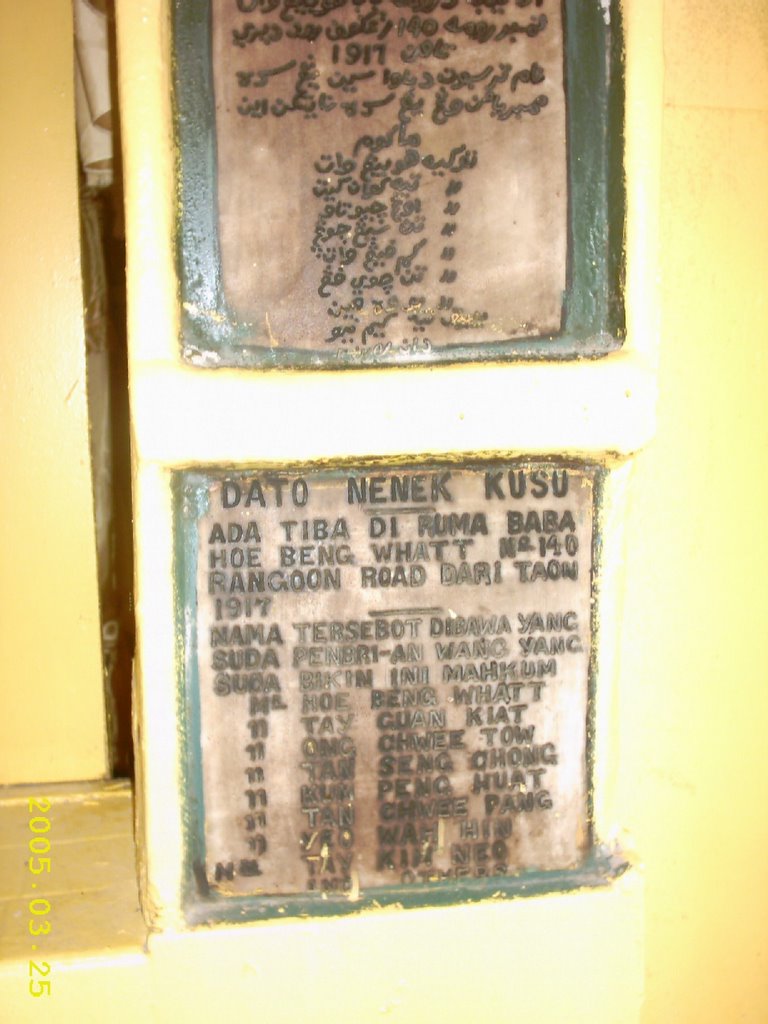
To reach the Keramats’ shrine, one has to climb 152 steps. The shrine houses the remains of Syed Abdul Rahman, his mother Nenek Ghalib and his sister, Puteri Fatimah. They had lived around the time of Stamford Raffles in the early 19th century. Devotees would pray to these Keramats for wealth, fertility, good marriage, and good health. As a mark of respect, visitors to the shrine would usually avoid having any dishes containing pork before making the trip.

Although there are Muslim symbols around this shrine - the star and crescent moon being the most obvious - the prayer ritual was rather "unusual". Devotees could "tiam yew" just like in the Taoist temples - i.e. for a small donation, the Malay caretaker would add oil to the lamps, ring a bell and chant some auspicious sayings before the keramat. Chinese joss-sticks were used apart from having the "kemayan" (incense) lighted before the deities.
On the day we visited, there were even 4-digits written on the joss urn - 9734. This came about because an elderly man had a lottery windfall after praying at this shrine. As a token of gratitude, he offered these numbers in the hope that other punters would be as lucky as him.

For landlubbers who eschew boat rides, there is a Kusu Tua Pek Kong Temple at Havelock Road, diagonally across from the Geok Hong Tian (see blog entry No. 13).

Contact:
The Sentosa Development Corporation (SDC) looks after Kusu Island;
for inquiries, call SENTOSA 1800-736-8672 (9am to 6.30 pm)

Ack: taoism-singapore@yahoogroups.com